Posted Feb, 2026
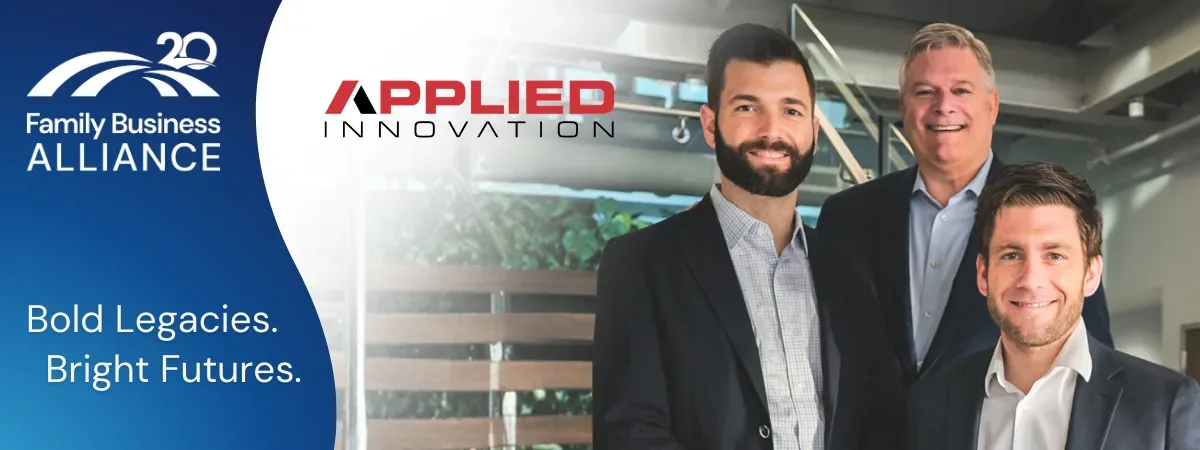
Applied Innovation Across Generations
Family businesses are never just about numbers. They are about late nights at the kitchen table, tough decisions that no one else sees, and a belief that somehow things will work out. They are built on risk, grit, and the kind of determination that shows up long before success does.
At Applied Innovation, innovation was never a slogan or a marketing line. It was a necessity. It was how the company survived, how it grew, and how one generation prepared the next to take the business even further.
Built on $500 and Belief
For founder John Lowery, the journey began with conviction, grit, and very limited resources. “Sandy and I had $500. That’s all we had,” John recalls. “We borrowed five grand from my dad and got a line of credit on the house. That’s how we got started. We never ever had enough money. We were always scrambling.”
“…somehow, we sold a machine or leased a machine, collected the money, and got it in the bank. The employees never knew.”
The early years required constant resolve. “There were lots of Wednesdays where I would say, ‘Payroll’s eight grand. I have no idea how we’re going to make payroll,’” he says. “And somehow, we sold a machine or leased a machine, collected the money, and got it in the bank. The employees never knew.”
Despite the pressure, John remembers those years fondly. “It was stressful, but it was fun,” he says. “I always slept like a baby.”
Immersed from Birth
As the business grew, it also became inseparable from family life. That closeness left a lasting impression on the second generation. “It’s difficult to remember much of the business from when I was really young,” Casey Lowery says, “but I have vivid memories of the company Christmas party at our house when I was growing up. In a lot of ways, it’s hard to separate my family from the business. It was so intertwined in who we were as a family.”

A New Dream
Those early experiences shaped Casey’s path forward. “When I was young, I was fairly certain I was going to play in the NBA,” he says. “After I realized that wasn’t happening, I dreamed that someday I would be a part of the business. So, in many ways my dream of being in the business paved my path.”
With that clarity came intention. “It’s easier to see the path when you know where you want to be someday,” Casey explains. Even so, growth required discomfort. “There have been roles I’ve played in the business that I didn’t feel that I was ready for. However, if I was going to lead the company someday, I had to step up to get the experience to be ready for the future.”
“…if I was going to lead the company someday, I had to step up to get the experience to be ready for the future.”
How Innovation Turned Risk into Growth
Innovation played a defining role in both generations. For John, a turning point came in 2003 when he sought outside perspective. “We went outside and got consultants, and they taught us the benchmarks and best practices,” he says. “They also taught us how to recruit, hire, train, manage, and motivate. Those two things together were a real catapult for us in building an exceptional organization.”
For Casey, innovation has always been about evolution rather than disruption. “In our industry, organizations have been talking about diversification for over 20 years,” he says. “At Applied, one of our Elements of Success is creativity. We believe that if we make incremental changes to get better every day, we will continue to evolve, even if we don’t invent the next iPhone.”
Culture as a Competitive Advantage
That mindset helped shape one of Applied’s greatest differentiators. “The culture is what I’m most proud of,” Casey says. “We’ve been really focused on it for the past 15 years. Now the team has embraced it, and I feel that it has taken on a life of its own.”
John echoes that commitment. “The culture is super important to us,” he says. “One of the things we say is that passive leaders under-manage values. Proactive leaders over-manage values.” Those values, known internally as Applied Chemistry, are reinforced through storytelling and daily experiences that connect people to purpose.
“Passive leaders under-manage values. Proactive leaders over-manage values.”
Looking ahead, Casey sees the future clearly rooted in people. “The team excites me the most,” he says. “I feel proud to work alongside people that are great at what they do and are flat out great people. Anytime you have a group of people pulling in the same direction, it’s hard to not innovate and make progress.”
From Founder to Steward
Legacy, for both generations, is about stewardship. “We wanted to control our destiny,” John explains. “We wanted to stay independent so we could make decisions that are good for employees and for the perpetuation of the business.”
Casey views that responsibility through the lens of leadership. “Legacy can be defined a few different ways,” he says. “It’s how you will be remembered as a leader.” One lesson stands out. “I had a mentor tell me once, ‘Be someone that other people would want to work for.’ That has always stuck with me.”
John hopes the future reflects continuity rather than his own presence. “I want people to look at the company and say, ‘John’s not in the day-to-day anymore, but the team he helped build is carrying on and continuing to grow,’” he says. “If that’s the case, then we did our job.”
Bold Legacies. Bright Futures.
At Applied, bold legacies are honored through resilience, values, and thoughtful innovation. Bright futures are built by leaders who remember where the business started, protect what makes it special, and keep evolving so the next generation can go even further.
Learn more about Applied Innovation at https://www.appliedinnovation.com/
Family Business Alliance provides tools, resources, and connections to help family businesses succeed. Learn more about our resources including Leading Forward, Succeeding in Succession, and Forging Frameworks of Governance that help to advance family business in our community.


Leave a Reply