Posted March, 2026
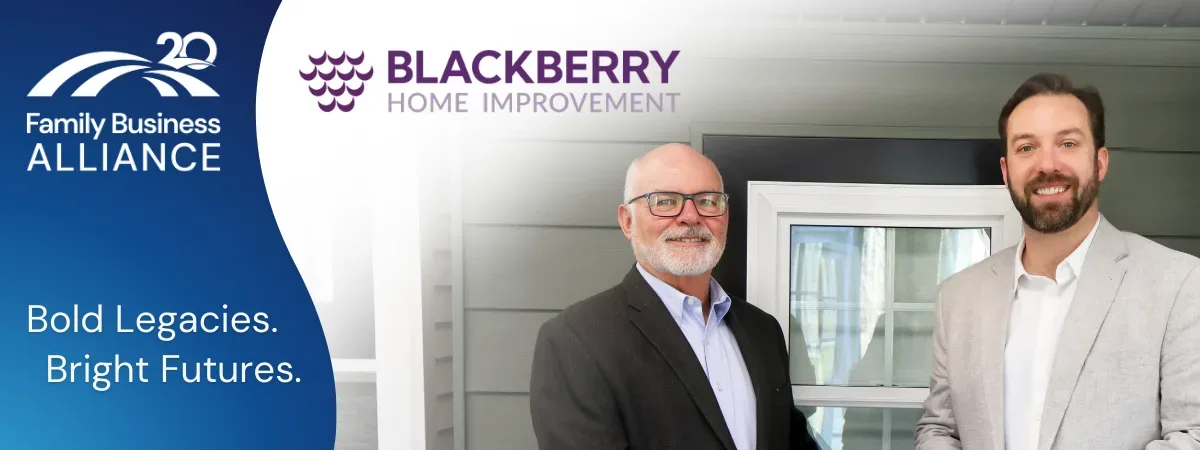
Family business succession rarely follows a perfect plan. Sometimes the next generation grows up knowing they will take over. Other times, the future feels uncertain. For BlackBerry Systems founder Mike Shields and his son Cameron, the transition to second-generation leadership remained uncertain until the ending came into view, and there was one last chance to change it.
“That’s when I went, wow, I could see doing this for a long time.”
A Business Defined by Evolution
Mike founded BlackBerry Systems in 1980 with a clear vision rooted in his background in solar energy.
“BlackBerry started as a solar heating company, because that’s what my background’s in, solar heating, solar design. And so that’s how it started.”
At the time, rising oil prices and government incentives for alternative energy created the perfect environment for innovation.
“There was an energy crisis, and there was an oil embargo… and there were tax credits that if you installed alternative energy systems at your home you could get a pretty hefty tax credit.”
The business gained early traction, but when energy prices dropped and tax incentives disappeared, demand for solar installations quickly faded. Like many entrepreneurs, Mike had to pivot.
“We started looking for other energy-related products. Window was one… and that’s how the business really started.”
That shift, initially a practical decision, became the foundation of the company’s long-term success.
Years later, another pivotal evolution emerged when the company began restoring historic windows on landmark buildings, carving out a distinct niche in the marketplace.
“It was really cool to be working on these buildings… and that’s when I went, wow, I could see doing this for a long time.”
What started as a solar idea had become something entirely different: a company preserving pieces of architectural history.
A Company Name with a Story
Despite the naming parallels, BlackBerry Systems was around long before executives were typing emails with their thumbs.
After the original name choice turned out to be associated with a different business out-of-state, Mike had to quickly pivot. He was walking around his yard and munching on blackberries when it struck.
“Surely nobody else has this name. My guy looked it up in the system the next day, and I was right.”
Blackberries are known for growing almost anywhere and surviving just about anything. Which, in hindsight, is a pretty accurate description for the business’s unique journey.
Resilient. A little scrappy. And built to last.

Growing Up Near the Business, Not Inside It
Unlike many family businesses, Mike never assumed his children would follow him into the company.
Cameron remembers the business feeling more like background than destiny.
“It didn’t feel like we were really growing up in the family business… we really looked at it as just our dad’s job.”
That approach was intentional. Mike wanted his children to pursue their own interests rather than feel obligated to take over.
“That’s why I named it Blackberry, and not Shields,” he says.
Still, the connections were there. Cameron and his siblings worked in the company during their teenage years, learning firsthand what it meant to be part of the team.
“There are people that still work here that I worked under when I was 15, 16 years old,” Cameron shares.
Those relationships stayed with him long after he pursued a career elsewhere.
A Future Off Balance
For years, Cameron didn’t see himself taking over the family business. Even when family discussions about ownership arose, Cameron wasn’t an obvious choice.
“And at that time, I said no. I wasn’t staying in Michigan. And so, it was like, how am I going to own a business in Michigan? I’m not staying here, so that’s not going to work,” Cameron says.
That uncertainty grew when a potential succession plan suddenly changed.
Cameron’s sister had previously been involved in the business and had even considered purchasing it. When she decided unexpectedly to move out of the state, Blackberry’s sale loomed.
At the time, Mike was nearing retirement.
“My dad was 68, maybe, and his transition wasn’t clear. One of the options was maybe the business wouldn’t continue, or it would be sold to an outside third party.”
For Cameron, that moment sparked a new way of thinking about the company’s future.
“It started to feel, not because of pressure from my dad, but like I needed to help provide a transition.”
At first, he didn’t imagine stepping into ownership. The idea felt temporary, more like helping out than taking over.
But the more time he spent around the business, the more something deeper began to take shape.
Cameron saw a company doing meaningful work, and doing it well. More importantly, he saw the people behind the company.
Many employees had been with BlackBerry Systems for years, building careers and relationships inside the organization Mike had created.
“The employees that we’ve had for so long… it just felt like, how could we not continue to provide that place to work?”
That realization changed everything.
“That is what really sparked the interest.”
Cameron began to see a future where he could lead the company forward.
A Defining First Year
On January 1, 2025, Cameron officially became the owner of BlackBerry Systems.
The transition was both exciting and daunting.
“Once you press play and go live, it’s different.”
The first year brought immediate challenges. Demand in the construction industry softened, creating a tougher environment than expected.
At the same time, Cameron and his wife were starting a family.
“My wife and I also started a family in the same year I bought the business… that was a lot of pressure.”
Yet the experience proved invaluable.
“This first year… I feel like it’s going to be a year that sets me up for success going forward.”
With Mike still nearby as an advisor, Cameron was able to navigate the early challenges while establishing his own leadership style.
“The number one most important ingredient is employees. And the beauty of a corporation is, I might own a corporation, or a group of people might own a corporation, but we are not the entity. It’s its own entity. I’m just another employee.”
Redefining Legacy
For Cameron, stepping into ownership has also changed how he thinks about legacy.
“I hope it’s defined by actions taken… hopefully the people that were around me feel like their lives got better.”
Rather than focusing solely on growth or expansion, he measures success by the impact the business has on its people.
Mike sees legacy in a similar way.
“It’s the values that the business developed along the way.”
For him, one principle stands above the rest: the importance of the team.
“The number one most important ingredient is employees. And the beauty of a corporation is, I might own a corporation, or a group of people might own a corporation, but we are not the entity. It’s its own entity. I’m just another employee.”
The Power of an Unexpected Transition
In many ways, the story of BlackBerry Systems reflects a reality many family businesses face.
Succession doesn’t always happen according to plan. Sometimes the next generation steps forward not because they were expected to, but because they see something worth continuing.
For Mike, the business began as a bold idea during an energy crisis.
For Cameron, the decision to lead came years later, sparked by a desire to protect what his father had built.
Together, their story reflects what family enterprises do best: adapt, endure, and evolve.
A bold legacy.
A bright future.
Learn more about Blackberry Systems at https://blackberrysystems.com/
Family Business Alliance provides tools, resources, and connections to help family businesses succeed. Learn more about our resources including Leading Forward, Succeeding in Succession, and Forging Frameworks of Governance that help to advance family business in our community.


Leave a Reply