The Welsh Wire: Being a Non-Family Leader in a Family Business ft. Dave Russell from Hastings Hot Line Tools & Equipment
The Welsh Wire: Inside the Advanced Manufacturing Expo with Creston Industrial’s CEO
The Welsh Wire: Brewing Success with Chris O’Neill of One Well Brewing
Family Business Leader Spotlight: Sheri Welsh
Entrepreneur-at-Heart to Family and Small Business Champion
From solo founder to family business leader, her journey didn’t just build a company—it ignited a passion for advocating on behalf of thousands of small business owners.
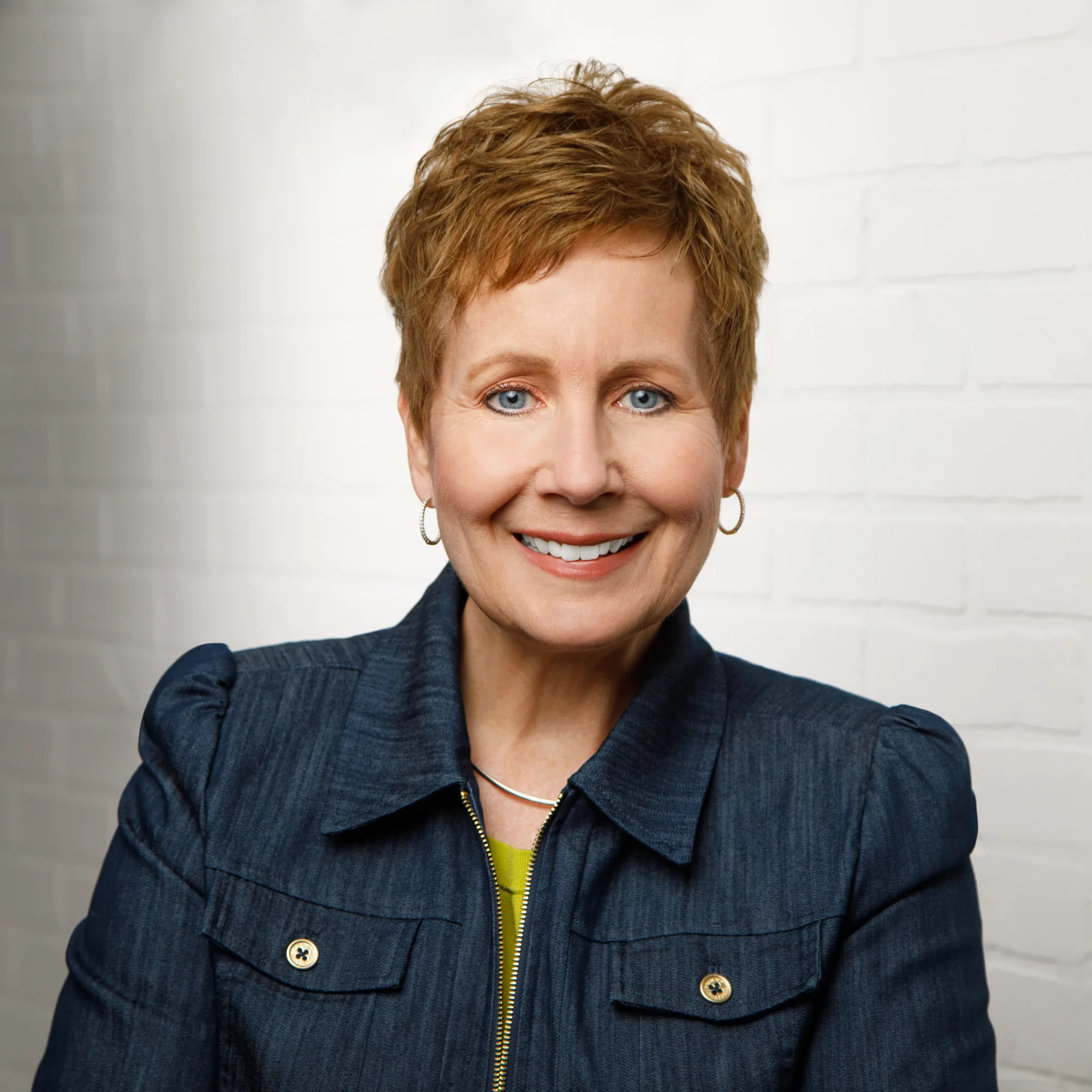
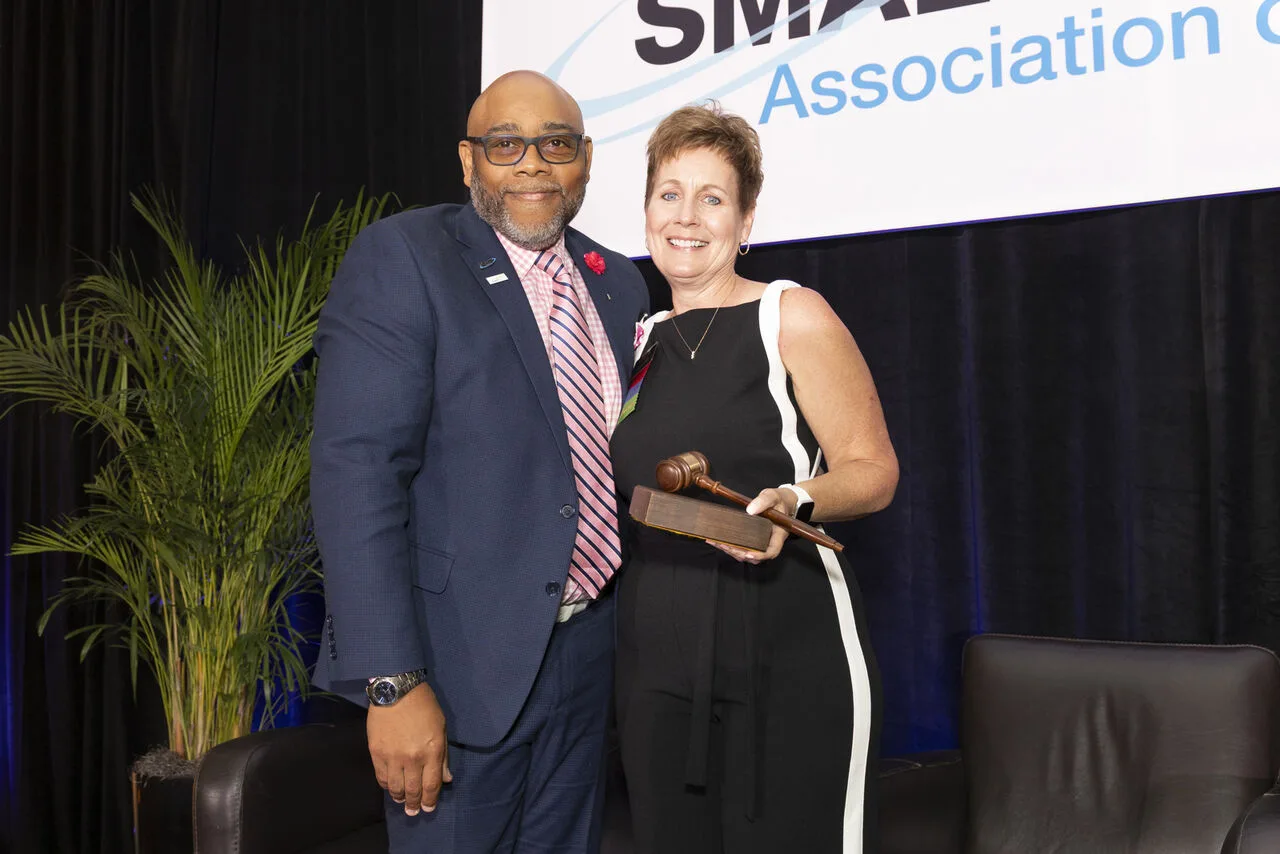
Small Business Association of Michigan, Chair
How did your family business journey begin?
I grew up working in our family business which my dad started in 1976, but honestly, I never had a desire to join the company after college (sorry dad!). I did however, always want to start my OWN business – I even mentioned it as a goal in my senior yearbook! When I started Welsh & Associates, I could never have envisioned that we would become a family business. I was delighted when my son approached me and wanted to join me in the work! Today, both my son and daughter-in-law work in our business and it brings me great joy to share the journey with them.
What has surprised you the most about your family business journey?
How respected and trusted family businesses are. As a kid, working in my dad’s business in a small town, I never realized that. Now, living it out in our business, our clients and candidates tell us how much they appreciate the culture we have created in our family business, which is a large part of what makes us unique and creates a competitive advantage in our industry.

What leadership lesson(s) have you learned that you want to pass on to the next generation?
There are so many! And I learn more every day. The most important ones are:
- Take good care of the people that take care of you. Your employees and your clients are your most valuable assets. Treat them with appreciation and kindness every day.
- Seek first to understand – then be understood. I borrowed that from Covey, but listening to others with empathy and full attention creates deep understanding and develops healthy successful long-term relationships. It’s all about people.
- Take care of the goose that lays the golden eggs. If you don’t take care of yourself first, the golden eggs WILL stop. It’s game over – for you, your family, your business (Covey Principle).
How did you become involved with Small Business Association of Michigan (SBAM)?
I joined SBAM as a member in 2012, with a desire to be part of an organization that advocated for the success of small business. I was not disappointed! Shortly thereafter, I began serving on Leadership Council and eventually joined the board of directors. It’s been a joy to serve at SBAM for well over 10 years and represent the interests of our 33,000+ members statewide as we work to make Michigan a place where all small businesses can grow and thrive.
How has your own experience as a small business owner shaped your leadership at SBAM?
This is one of the few boards I’ve served on where I have lived experience related to the work I’m engaged in. My small business, entrepreneurial experience completely shapes the perspective and leadership that I bring to my service at SBAM. After 23 years in business, I haven’t forgotten what it’s like to be in a start up phase, worry over a business blunder or have a sleepless night processing my next strategic move. I live out the daily challenges of running a business with my fellow members every day and I genuinely care about their concerns and needs – which are often the very same as mine. It’s an honor and a privilege to represent those concerns and work to address them in my role as Board Chair.
What are the biggest challenges small business owners in Michigan are reporting right now—workforce, inflation, access to capital?
Actually, one of the greatest concerns our members have right now is their ability to provide affordable health insurance for their employees. It’s no secret that insurance providers have been passing along double digit increases to Michigan’s small businesses for the past several years. This is making the cost of providing health insurance benefits nearly untenable for many small businesses. SBAM has been at the forefront of raising this issue and convening conversations to address skyrocketing costs. There is no easy answer to this challenge, but we’re willing to address it on behalf of Michigan’s small businesses.
What types of resources or programs have proven most impactful to your members?
Of recent, three programs come to mind:
- When ESTA was passed by the Michigan Legislature, it sent shockwaves through the small business community. SBAM was at the forefront of providing information, webinars and a toolkit to its members, helping them navigate through compliance with this new legislative mandate.
- SBAM’s Small Business Support Hub Grant provides free programming, courses, events and support to businesses who were disproportionately impacted by the COVID-19 pandemic. We have helped hundreds of businesses recover from the devastating effects of the pandemic.
- Nurture Benefits is a new program we are launching this fall. This program is designed to expand access to health, life and retirement options for child care professionals across the state. The program aims to grow and stabilize Michigan’s early childhood workforce by making it easier for child care providers to attract and retain career professionals.
What is bringing you joy?
I sincerely find joy in many things which include my faith, my family, my work and giving back to my community. However, right now, I’m EXCEPTIONALLY joyful about my first grandchild, born June 27th AND a second grandchild coming in November! It is truly pure JOY!

Welsh & Associates
Founded in 2002, Welsh & Associates is recognized as an industry leader in executive and employment recruiting services by companies across the nation, including key markets throughout West Michigan.
FEUSA Tax Teams Focus on 2025 Tax Bill

By Pat Soldano
It’s looking more and more like a salvage operation on Capitol Hill as the Tax Cuts and Jobs Act provisions are being examined, culled, embellished, and reconstituted before it expires at the end of next year. But no matter, good, bad, or ugly, there will be a new tax bill in 2025.
As I write this, the House Ways and Means Committee is busy managing its ten Tax Teams to improve or save what it can from the 2017 Tax Cuts and Jobs Act (TCJA).
A few items on the salvage list include avoiding increased income taxes, stopping a decrease in estate tax lifetime exemptions, no increases in capital gains taxes, and restoring research and development expensing, to name a few.
As you may recall, the House Ways and Means Committee Chairman Rep. Jason Smith (R-MO) and Tax Subcommittee Chairman Rep. Mike Kelly (R- PA) formed ten Tax Teams earlier this year to study key provisions in the Trump-era
Tax Teams are set up as follows: American Manufacturing, Working Families, American Workforce, Main Street, New Economy, Rural America, Community Development, Supply Chains, U.S. Innovation, and Global Competitiveness. The stated goal of these teams is to: “help families, workers, and small businesses,” according to Smith.
What Are Key Tax Priorities?
But what are the key family business-oriented tax policies critical for our legislators to review? Our tax team experts on Capitol Hill have uncovered seven “Tax Policy Legislative Priorities” for the 119th Congress that will affect the funeral services industry.
In addition, this month we conducted a spot survey among 100 family businesses asking one question: “what is your number one tax priority?” But first, what are our seven Tax Policy Legislative Priorities? Here they are:
1.Preserve the current tax rates and brackets enacted under the Tax Cuts and Jobs Act. Family-owned businesses rely on the consistency of tax rates more than corporate businesses due to the increased complexity in succession planning. In addition, family businesses are uniquely suited to reinvest more in their business, their employees, and their communities, according to the results of our 2024 Annual Business Survey. In our survey, 52% of respondents indicated that if they paid less in taxes, they would invest more in the business, and 30% indicating they would raise their employees’ salaries.
2. Reduce the estate tax rate. Estate taxes severely hamper the ability for family business owners to pass the business and related assets (which are typically illiquid) to the next generation, making it more difficult for the business to continue growing, providing important jobs, and contributing to local communities. Of family businesses surveyed, 70% have generational employees and 81% have been in operation for 20 years or more. Eliminating the estate tax consistently ranks among the top three priorities.
3. Make permanent the Section 199A deduction for passthrough businesses. The Tax Cuts and Jobs Act included a new deduction to help ensure business owners pay tax rates more comparable to the corporate tax rate reduced by the TCJA. If allowed to expire, the section 199A deduction will be uniquely and severely disadvantage passthrough businesses. Of family businesses surveyed in our annual study, 78% operate as passthrough businesses, whether a partnership, LLC, S corporation, or other non-corporate structure.
4. Restore the full deductibility of research and development (R&D) expenses. The R&D deduction has historically been a bipartisan issue, gaining support from both parties in discussions on economically beneficial provisions to include in a 2025 tax bill. According to our family business survey, 22% of family-owned businesses are in the manufacturing/operations industry and 11% are in the construction/facilities industry, which rely heavily on R&D investment.
5. Restore 100% bonus depreciation. Next to their commitment to their employees, family-owned businesses rely on capital investments to compete, grow, and thrive. Bonus depreciation is a critical tool for family businesses to support their capital investments and finance facilities and equipment critical to their ability to grow, expand employment, and contribute to the communities in which they operate.
6. Preserve the capital-gains tax rate. Like the estate tax, the capital-gain taxes present an obstacle for capital formation and investments necessary for family businesses to expand, modernize, and succeed in an increasingly competitive market, with 13% of family businesses ranking it in their top three tax policies of concern – a 4% increase over the 2023 Survey.
7. Prevent the creation of a wealth tax. Wealth taxes – taxes on existing assets and unrealized gains – will be particularly harmful to family business owners who often disproportionately invest in the business in the hopes of passing it on to the future generations. In the most recent Family Business Survey, respondents identified preventing a “Wealth Tax” as one of their top five economic priorities – a concern that was nonexistent in prior years.
Top Of Mind Taxes
To further solidify thinking on tax priorities, this month we conducted a “spot poll” of 100 family-owned businesses on the topic of taxes in 33 states.
In this “Tax Policy Priorities Poll” we asked what their greatest tax concerns were right now, from increases in income taxes, to no increases in estate taxes, to restoring research and development expensing. The results showed the following percentage ranking for the top tax concerns by family business respondents.
The top concern was “No decrease in Estate Tax Lifetime Exemption,” which received 30% of votes from respondents, including those in the funeral services industry.
In a close second place, family businesses want to see “No Increase in the Income Tax Rate,” which received 28% of votes.
When it came to “No Increase in Capital Gains Tax Rate,” 13% respondents felt this was a top tax concern, while “Establishment of a Wealth tax” received 11% as a top priority. The “Wealth Tax” worry is trending upward.
Finally, such priorities as “Keep 199A Deduction for Pass Through Entity” worried 10% of family business respondents, while “Restoring R & D Expensing” got 4% of the vote.
Lastly, when asked the question about “Restoring Bonus Depreciation,” only 3% replied this was a top priority.
Let Congress Know
Nobody knows what Congress, or the new White House, will ultimately agree on when it comes to taxes, or how they will manage the growing gap between revenues and expenses, but everyone agrees there will be a new tax bill in 2025…good, bad, or ugly. The only way to state your case is to voice your concerns. The Congressional Family Business Caucus Meeting was held on Sept. 18 and in the meeting addressed pass-through taxes, enterprise structure, and possible wealth tax legislation.
Pat Soldano is the President of Family Enterprise USA and the Policy and Taxation Group, both nonpartisan organizations advocating for family enterprises of all sizes. They are the organizers of the Family Enterprise USA Annual Family Business Survey 2024 and assist in organizing the Congressional Family Business Caucus.
Yellowstone: Will Beth Dutton Save the Kingdom?

From Philo.com
Tradition and Change in Family Business: A Yellowstone Parallel to Reality
Like many family business leaders, John Dutton struggles to uphold longstanding traditions while external competitive pressures mount and next-gens clamor for change. “Yellowstone” is an American Western drama series that has portrayed the conflicts associated with a cattle ranch family business that began back in the 1890’s with the development of the American West. The much-anticipated final season debuts November 10, 2024.
The series stars Kevin Costner as John Dutton, the current patriarch, who is struggling to keep the business afloat to honor the legacy and the land he has inherited. External environmental and competitive forces have made the cattle rancher’s way of life harder to preserve. Dutton also has three surviving children who are fighting for their own goals, or against each other, which makes leadership transition or any other change very challenging.
So many unresolved issues remain before the series rides into the sunset – issues that mirror the real-life family business challenges that I’ve encountered as Director of the West Michigan Family Business Alliance. For instance:
- Who will win the siblings’ war for recognition, power and control: Beth, the devoted, tough, and business savvy daughter who seeks to protect her father at all costs; Jamie, the adopted son who lacks self-confidence and has consistently struggled to gain acceptance to the point of betraying his father; or Kayce, the only one who loves and embraces the cattle rancher’s way of life but seems uninterested in running the business?
- With the family’s livelihood and estate dependent on bringing the cattle to market, will this year’s cattle survive the illness spreading throughout Montana and killing the livestock?
- Will Kayce, and his Native-American wife, finally resolve their cultural differences rooted on the displacement of the Native American Indians during the American West development in the eighteenth century?
- Will John Dutton accept the changes suggested by his daughter Beth to keep the ranch profitable?
The most intriguing challenge is the current patriarch’s struggle to keep his family’s ranch – a kingdom of the size of Rhode Island – while upholding the traditions of the cattle ranching lifestyle in a challenging competitive landscape. Paradoxes are inherent to family businesses (Schuman, Stutz and Ward, 2010) and, like John Dutton, family business leaders must balance long-standing traditions with the need for change and innovation (McAdam, Clinton, & Dibrell, 2020). Successful family businesses must also identify what to preserve and what to let go of. This is called temporal symbiosis: the ability to concurrently perpetuate tradition while achieving innovation, acting as a “shield of the past and an engine for the future.” (Erdogan, Rondi and De Massis (2020).
The Struggle Between Tradition and Innovation
Family businesses are seen as protectors of the tradition, transmitting beliefs, practices, and legacies across generations, which together can limit the change needed to remain competitive over time (Erdogan et al., 2020). In “Yellowstone,” John Dutton’s tradition implies family loyalty, long and hard workdays herding cattle, and completing cattle drives by horseback. But his cattle ranching methods are not enough to withstand market disruptions, disease and the rising costs of operations and taxes. The ranch’s inability to vertically integrate downstream threatens not only its profitability, but also John Dutton’s ability to keep the promise made to his father of preserving the land for future generations.

From Pexels.com
Meanwhile, the next generation is not as aligned with the family business’s older ways, and the current generation struggles to keep them involved and engaged (Mc Adams et al, 2020). Beth Dutton, the next generation, envisions a different path forward. She breaks down the numbers for her father: the cattle are worth roughly $1.50/pound, hamburger is valued at $5.00/pound, and a good steak is worth roughly $39.00/pound. And another ranch, 6666, has sold over 8 million pounds of beef from their online website. Beth points out that while cattle ranchers sell cattle, ultimately selling beef is far more profitable. The money made from selling beef will create more financial stability for the Dutton family and could secure the land for future generations. This is a perfect example of vertical integration, without compromising tradition. She will do anything to keep her father happy and consequently save the family legacy and the ranch.
How Family Firms Can ‘Save the Ranch’
While the Dutton family and “Yellowstone” may be a dramatized example, laying the groundwork to avoid drama starts well before the conflict begins in family business. Successful transitions require engagement from both the current and the next-generation leaders. Past research (Kreg & Moores, 2017 and Craig, 2021) and my own experiences show that
Next-generation leaders are:
- Preparing and developing their business and leadership skills to move the business forward.
- Taking initiative (often without waiting for the baton to be passed).
- Developing a collaborative leadership style with trusted advisors and allies.
- Developing an entrepreneurial skillset and nurturing to establish this culture in the business.
The best current generation leaders are:
- Establishing trust in their next gen; treating them as equal business partners and not children.
- Providing them with a career path preparing them to lead the organization and to make their own decisions and mistakes.
- Recognizing that the next-generation leaders have different skills and will do things differently.
- Supporting the next-generation leadership development through a peer network, leadership training, and elevating professional opportunities within the organization.
- Learning to let go and move on.
Like other family businesses, Yellowstone’s path for future generations is not clearly defined or guaranteed. The above suggestions might help family businesses facing similar challenges chart a new vision to move forward, protect the business, and preserve the family legacy. While Beth Dutton’s solution is not the exact business the ranch has always been in, it could allow it to move forward. If John Dutton embraces this new vision and transition, he will be following his own advice to his troubled son Jamie: “Your grandfather used to say you can’t fix a broken wagon wheel, but you can use the parts to make a new one.”
Family Business Alliance strives to help family businesses with the tools, resources, and connections to help businesses succeed. Learn more about our resources including Leading Forward, Succeeding in Succession, and Navigating Governance that help to advance family business in our community.
Written by: Robin Burns, Family Business Alliance and Ana Gonzalez, Grand Valley State University
References
Craig, J. B., & Moores, K. (2017). Leading a family business: Best practices for long-term stewardship. Bloomsbury Publishing USA.
Craig, J. B. (2021). Continuity Model Generation: Integrating Wealth, Strategy, Talent, and Governance Plans. John Wiley & Sons.
Erdogan, I., Rondi, E., & De Massis, A. (2020). Managing the tradition and innovation paradox in family firms: A family imprinting perspective. Entrepreneurship Theory and Practice, 44(1), 20-54. https://doi.org/10.1177/1042258719839712
McAdam, M., Clinton, E., & Dibrell, C. (2020). Navigation of the paradoxical landscape of the family business. International Small Business Journal: Researching Entrepreneurship, 38(3), 139–153. https://doi.org/10.1177/0266242619898610
Schuman, A., Stutz, S., & Ward, J. L. (2010). Family business as paradox (pp. 22-29). New York: Palgrave Macmillan.
Subscribe
"*" indicates required fields
The Welsh Wire: Lessons from a Trailblazing Female CEO in Concrete ft. Adrienne Heidema
A Testament of Timber: The Legacy and Innovation of L.L. Johnson Lumber Mfg. Co.

L.L. Johnson Lumber Manufacturing Company, a name synonymous with woodworking excellence, celebrates its 115th year, marking a milestone in its legacy of craftsmanship, innovation, and quality. Based in Charlotte, it is Michigan’s longest-running hardwood lumber distributor, with seven warehouses and two retail storefronts. We spoke with fourth- and fifth-generation leaders Tim and Connor Johnson to discover what drives this West Michigan business. Their story showcases an inventive spirit, family values, and an unwavering pursuit of quality.
A Leap of Faith: From Savings to Sawmill
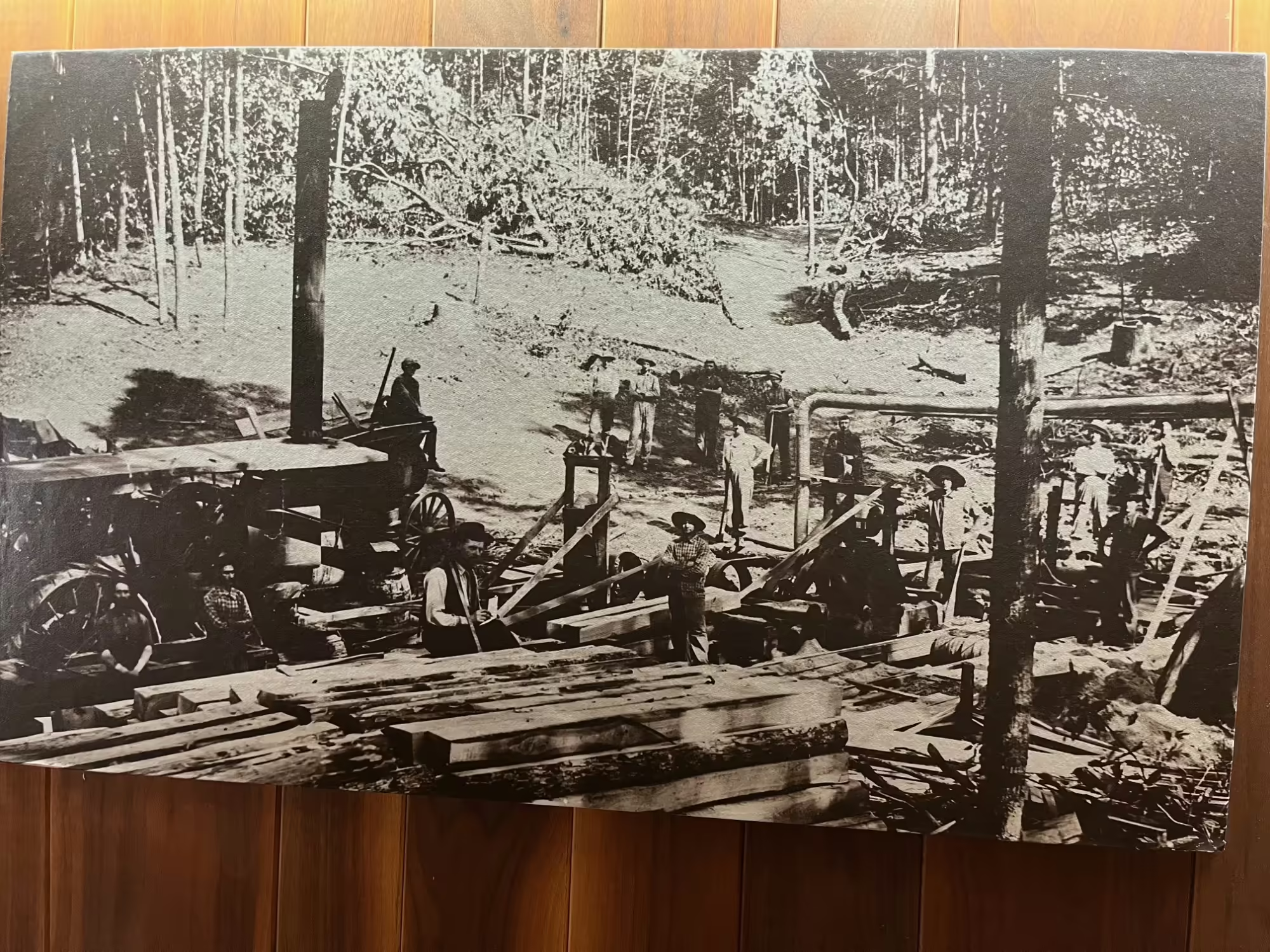
It was 1909 when 34-year-old Laurin Lewis (L.L.) and his wife Zae boldly invested her hard-earned teacher’s savings in a portable sawmill. Their mission: to supply the booming railroad industry with high-quality hardwood lumber. As L.L. crisscrossed Michigan’s woodlots for a decade, their mobile operation paid off, producing half a million feet of railroad ties and crossing planks annually. This relentless dedication set the stage for a family business that has not only survived but thrived for over a century.
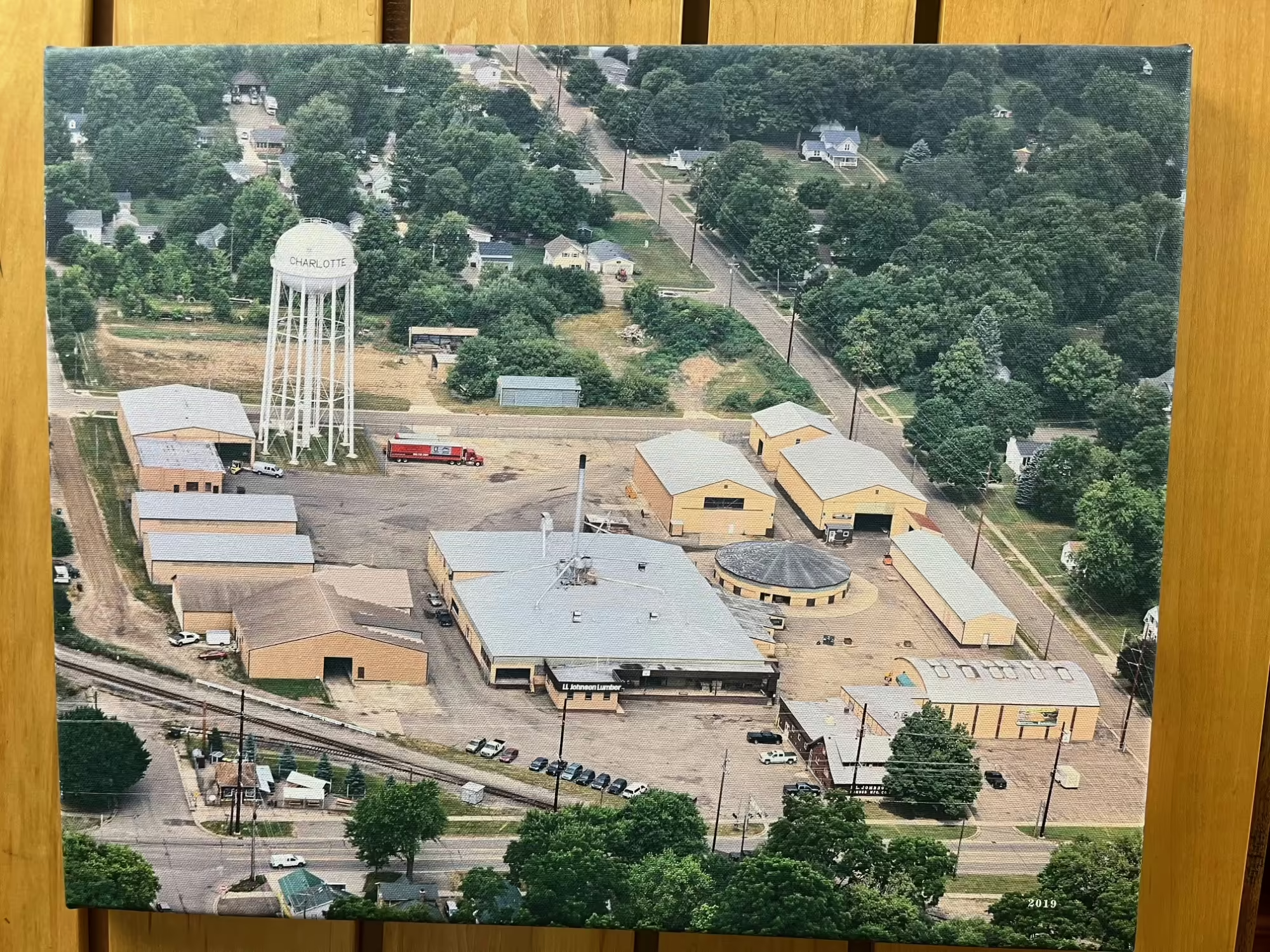
Today, with Tim and Connor Johnson at the Helm, the mill no longer processes whole logs; it still machines rough lumber on an 11-acre campus, which includes the iconic water tower owned by the city, seven warehouses, and a fleet of six delivery trucks. The lumber they sell is kiln-dried and graded, sourced from suppliers around the globe. By adopting a worldwide approach and catering to niche markets, L.L. Johnson operates as a versatile wholesale distributor, continuing the legacy that began with L.L. and Zae’s leap of faith over a century ago.
“We’ve been able to do this for over 100 years because you treat people right,” says Tim Johnson, who leads 47 employees. “You do the right thing — it’s just common sense.”
History Lessons: Pivots from Rails to Furniture
In 1922, when the railroad had grown beyond the state, L.L. set up shop permanently in Charlotte, strategically closer to the growing auto industry. Manufacturers needed to make cars and trucks, and the company’s annual production soon doubled. When steel began replacing wood by the end of the decade, L.L. started to look for new markets, turning his attention westward toward the Grand Rapids area.
Around this time, L.L.’s son, Darrel, joined him, having gained experience working with another supplier in the Midwest. Together, the father-son duo redirected efforts to supply “Furniture City” with the lumber required for its manufacturing needs. To support this new focus, they upgraded operations with a band sawmill, built dry kilns, and established warehouse facilities. As a result, the main plant in Charlotte employed a workforce of 29 by 1930. These strategic changes ensured the company’s survival and growth during the Great Depression.

Innovation and Expansion: The Third Generation’s Vision Unfolds
Although the furniture market sustained the business for decades, the Johnsons continued seeking opportunities for growth. This entrepreneurial spirit attracted Darrel’s sons—Dick, Bob, and Ted—to join the team in the 1950s, marking the beginning of the third generation’s involvement in the company.
The family business was incorporated in 1966 and underwent its largest expansion, introducing new machinery to mechanize the cutting, edging, resawing, and trimming of logs. In a demonstration of ingenuity, Dick and Ted Johnson designed a 40-foot diameter revolving round table for sorting lumber inside an 80-foot round building. This game-changer consumed just a tenth of the power required by conventional green chains used in most mills. The round building and table became a landmark advancement in the hardwood lumber industry, drawing business owners from across the country to Charlotte and solidifying their reputation for engineering excellence. By the 1970s, Johnson’s Workbench, a retail operation for hobbyists and professionals, opened its doors in Charlotte.
Digital Transformation: The Fourth Generation Leads the Way
From 1977 through the mid-eighties, the fourth generation — Mark, Steve, Mike, and Tim — began working for the company to modernize its physical and technological operations. Advanced computerized inventory and pricing systems were implemented, and the company’s website was launched.
“You won’t find these products or lines at Home Depot,” owner Tim Johnson says. The company offers over 100 domestic and exotic hardwood species, including Eastern White Pine and marine-quality plywood. Specializing in one-of-a-kind offerings, the company’s dedicated warehouse is stocked with unique and hard-to-find products. “That’s our game, that’s our thing,” says Tim Johnson. “We focus on carrying the kind of items you won’t find anywhere else.”

“I’ve had the pleasure of working with Johnson’s over the years, and I couldn’t be happier with their service let alone the quality they have to offer. The large variety of lumber, tools, machines, and materials they offer has consistently exceeded my expectations.” – John Geddie, Heirloom Woodwork
Honoring the Past, Building the Future
In 2008, Tim and Mark Johnson officially became the company’s new owners. A year later, Wood & Wood Products magazine named it one of the nation’s Top 100 Fastest Growing Wood Products Companies. Their commitment to innovation spurred them to tackle environmental challenges directly, ensuring the company stayed ahead in sustainable practices.
“It’s a difficult market,” says Tim Johnson. “Trees are growing plants that need harvesting. Managing them right, taking care of them, and planting more than we take is crucial to our industry.”
The company sources wood from responsibly managed forests and employs advanced technology to minimize waste and reduce its environmental footprint. For instance, it uses a thermally modified process to treat ash trees damaged by the emerald ash borer, an invasive beetle from eastern Asia. By thermally treating the wood, the Johnsons create an eco-friendly product from trees that would otherwise go to waste.
“We’re able to heat it up to a high degree, which makes it moisture-resistant and ideal for outdoor use,” says Tim Johnson. “It’s really pretty with a light brown hue, and because it was an ash tree that was soon going to be lying on the ground anyway, it’s a sustainable, eco-friendly solution.”
This commitment to sustainability aligns with their focus on meeting customer needs with precision. “We’re always working to meet customers where their demand is,” says Connor Johnson, Tim’s son and a fifth-generation leader of the company.
The company’s strength lies in finding the perfect balance between large and small orders. “We’re unique—we can sell by the semi-load or just a few pieces at a time,” says Tim Johnson. “It’s a sweet spot we’ve positioned ourselves in. I believe we’re the only ones in Michigan where you can buy just one board or an entire truckload.” No matter the size or the request, L.L. Johnson finds ways to meet those needs, standing as a steadfast partner in every woodworker’s journey.

In an industry shaped by shifting markets and environmental challenges, L.L. Johnson stands out not just for its products but for its commitment to doing the right thing—ethically, sustainably, and with an eye toward the future. The story of L.L. Johnson is not just one of survival; it is a narrative of enduring success, driven by a relentless pursuit of quality and a deep respect for the craft.
This interview has been edited for length and clarity. Email fba@fbagr.org if you are interested in exploring feature opportunities.
Family Business Alliance strives to help family businesses with the tools, resources, and connections to help businesses succeed. Learn more about our resources including Leading Forward, Succeeding in Succession, and Navigating Governance that help to advance family business in our community.
The Welsh Wire: Managing Business Growth and Family Dynamics ft. Michelle Timmerman of Direct Supply Inc.
The Welsh Wire: Transitioning Leadership in a Family-Owned Business ft. Marlee D’Arco of Safety Services, Inc.
Four Generations of Artistry in Metal Work: Buist Sheet Metal

Buist Sheet Metal’s Shining Legacy of Craftsmanship
“There will always be people who value high quality work, so if you maintain that, you’ll have work.” That’s the insight from his grandfather that resonates most with Don Buist, fourth generation leader of Buist Sheet Metal. In more than 20 years working for his family business, that is exactly the legacy he strives to honor.
Since 1947, Buist Sheet Metal has provided quality, custom architectural metal work to West Michigan. The family business specializes in standing seam metal roofs, metal wall panels, copper roofs and accents, and slate and clay tile roofing. Customizing everything in-house, they fabricate and install each of their jobs with care and precise attention to detail.

Finding their Niche
Making and forming their panels in house, they can create continuous length and custom width panels versus being limited by pre-made options. This, Don said, “Creates a really polished, finished look.”
With this expertise, the Buist family carved a niche in the industry. The family business has contributed to intricate, unique projects such as The Amway Grand Plaza’s Pantlind Hotel roof detailing, Grand Valley State University’s copper archway, metal paneling for the John Ball Zoo’s Bissell Treehouse, residential restoration projects throughout East Grand Rapids, and countless new homes.

With every project, they start from scratch, detailing the design and layout to ensure the result is seamlessly customized. The level of detail they put into roofs is above and beyond, Don shared. “We’re very intentional about the final look, making sure everything is aesthetically pleasing.” Describing the intricacies of numerous projects, Don’s pride in their work and reputation is evident.
Forging Relationships & Reputation
In exceeding the expectations of their partners and clients, they have built strong relationships in the building and architectural community.
“A lot of the work we do is built on the relationships we have with the builders and contractors who know and trust us, know and trust our team. We’ve earned their trust because we’ve problem solved; we’ve done complicated jobs.” The trust of their partners is testament to their skills, acumen, and legacy that they have carefully crafted through generations.

The Team
For the Buist Sheet Metal team, the precise work requires a specialized skill set, Don explained. The longevity of many of their team members is impressive, with several employees having tenured careers spanning multiple decades.
Currently looking to add new team members, Don shared that they are happy to mentor employees and help them gain valuable skills toward a meaningful, skilled career. He expressed, “I hope to continue to grow and develop new talent. And continue to bring in good, quality team members who can build on the quality of the past. We have a great young team. It’s a great place to be.”
The Early Days
Dating back three generations and almost 80 years, Don’s great grandpa, Gerrit, founded Buist Sheet Metal in 1947 out of his garage. Gerrit’s son, Don Sr., joined him shortly after. Don said during high school, his grandpa “would work from 6-8am before school. Then, my great grandpa would be waiting there when he got out of school and worked until 8pm.” By the time he finished 11th grade, Don’s grandpa wanted to work full time. Despite his dad’s protests, he did.
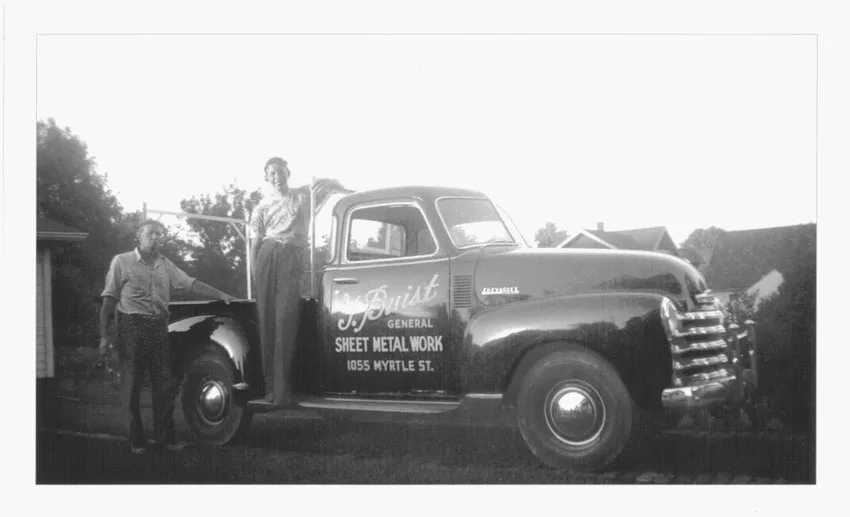
Within a few years, they built a small shop on the West Side, moving out of the garage. In 1956, the founder passed away unexpectedly, leaving his two sons to run the business. As Don explained, “In a lot of respects, it’s more like my grandpa and his brother were first-generation. They were in their 20s when their dad passed away. Their sister did the books, and they ran it together for 20+ years.”
Transitions
Don’s father, Jim Buist, graduated college in 1975 and began working full time for the company, eventually succeeding the business from his father. Don followed a similar path. He graduated with a business degree in 2005 and came on full-time, after seven summers of working for the business. Don started out working on job sites, often beside his grandfather in the early years. Witnessing his father and grandfather’s passion ultimately translated to his own.
After a forty-five-year career with Buist Sheet Metal, Jim succeeded the business to Don. Although Jim is no longer involved in the day-to-day operations, “he is always available as a sounding board for me,” shared the fourth-generation president.

Legacy
To this day, Don is passionate about the work of Buist Sheet Metal and its legacy. “My grandpa is 91. He’s happy to see the business is still thriving. He knows we’re doing good, high-quality work yet, and I think ultimately that makes him proud.”
Both through their contributions to custom homes and their renovation work, Don feels Buist Sheet Metal provides a unique service to the community. The family business has serviced ample historic homes, buildings, and churches throughout West Michigan, restoring their metal and copper work to maintain the original integrity or match details on future additions. Some have been repeat jobs, he explained. “There are properties I’ve worked on that my grandpa worked on.”
The Future of the Business
Aside from growing his team and the business in years to come, Don is excited about the future of Buist Sheet Metal and maintaining their niche. When it comes to his fifth generation following in his footsteps, he is open to many possibilities. “Time will tell,” he said, “and I’ve got time. It’s always in the back of my mind. I’ve built my life and career around the legacy before me, but my dad never pressured me to come in here. That’s exactly where I’m at with my family.”

This interview has been edited for length and clarity. Email fba@fbagr.org if you are interested in exploring feature opportunities.
Family Business Alliance strives to help family businesses with the tools, resources, and connections to help businesses succeed. Learn more about our resources including Leading Forward, Succeeding in Succession, and Navigating Governance that help to advance family business in our community.
Verhey Carpets: Celebrating 75 Years of Rich Family Business Heritage

Threads of Time: Small Business Stories from West Michigan’s Oldest Floor Covering Company
Family-owned businesses are the backbone of many communities. Aside from helping propel local economies, providing unique goods and services, and creating meaningful employment opportunities, the history and passion behind these businesses is profound.
The Beginning
Verhey Carpets, for example, is the oldest floor covering business in West Michigan, with three generations of family members stewarding it forward as history traversed outside its shop windows.
Founded in 1949, this family-owned floor-covering business has evolved alongside our growing region. From the post-WWII boom, race riots of the 60s, and most recently, the COVID-19 pandemic, this small business has seen it all.
“Forty-seven years – same parking lot, same door,” quipped Dave Verhey, second-generation owner and leader of Verhey Carpets. The home furnishings store was founded by his uncle, Neil Verhey on Wealthy St., just two doors down from its current address. In 2002, they added a showroom location on 29th Street. They joined Williams Kitchen and Bath Studio, Gerrit’s Appliances, and more, making the location a one-stop shop for homeowners.
Industry Leaders
“In 1949, there were no carpet stores. You bought carpets at department stores,” Dave explained. “This was the first floor covering store in Grand Rapids. Quickly after, there was one on every corner.” The end of WWII brought many changes. The increase in homebuilding changed the way floor coverings were purchased and helped strengthen the business.
Neil Verhey returned to the wholesale carpet industry in the 1950s and sold the business to Dave’s father

upon his return from the Korean War. At that time, Verhey Carpets was one of many storefronts along the bustling Wealthy St. corridor. It was accompanied by clothiers, shoe stores, music shops, and more, offering ample shopping for Grand Rapidians.
The business purred along throughout the post-war era until the race riots shook the city in 1967, altering the commerce landscape. “In the 70s, nobody would come to this location,” expressed Dave Verhey. The store remained boarded up for many years following, and his family’s store was the only one to stay. Verhey Carpets is one of the oldest tenants in the Wealthy St. Business District.
Dave recalled the day the boards were finally removed from windows, and the slow revitalization in the decades following. Dedicated to seeing the revitalization through, Dave’s father was part of the task force committed to uplifting the neighborhood. He led the Wealthy Street Business District at various times throughout the 1980s and 90s.
The history, stories, and longevity of the business is an element of pride both Dave and his daughter, Melissa Euker, carry.
The Stewardship Mindset

While Dave always knew he wanted to take over the family business one day, Melissa’s path was different. She began her career outside of the family business and valued her time working with a boss and colleagues who weren’t family. After having two children, “I couldn’t work 50 hours a week anymore, and I started working at Verhey.”
She began learning the business under her mom’s wing before her dad nudged her toward sales. She recalled him saying, “You’d be great at sales. You could go out to 29th Street. We love having you here at Wealthy. But we really need you to go out to the store that has the most traffic.” Today, she manages their 29th Street showroom and wears many hats, as many family business owners do. “I can’t imagine doing anything else. I absolutely love it. Just to be part of the history and the third generation, it didn’t mean as much to me back then as it does to me today.”
The stewardship, the legacy, and the impact that local ownership and small businesses have is unprecedented, and it becomes part of the fabric of a region.
Pride and Satisfaction

Aside from that, both second- and third- generation Verhey’s are proud of their servant leadership as small business owners, customer satisfaction, and overall expertise that Verhey Carpets has become known for in their three-quarter centuries of operation. “I think we do a great job of educating customers on natural materials, hard wood, wool carpets, and other environmentally friendly options,” Melissa said. Her father added, “We pride ourselves on good products that are unique, service that is as good as we can provide, and installation that is top notch. We’re selling happiness.”
Greatest Hopes for the Future
While they are looking forward to the future of their family business, they are taking the time to appreciate their 75 years of business. Melissa said, “75 years is pretty exciting,” and she looks forward to continuing their tenure as a family owned and operated business. As far as the fourth generations’ involvement, they do have a niece working Summers in the business, and “She really enjoys it.” Melissa is open to wherever her own children’s paths take them.
As for Dave, he is looking forward to retirement. “Forty-seven years – same parking lot, same door. I’ve been driving to the same place for forty-seven years, so I’m ready for a rest,” Dave said chuckling.
The interview was edited for length and clarity.
This feature is part of our Member Anniversary Program. Email fba@fbagr.org if you are interested in exploring feature opportunities.
Family Business Alliance strives to help family businesses with the tools, resources, and connections to help businesses succeed. Learn more about our resources including Leading Forward, Succeeding in Succession, and Navigating Governance that help to advance family business in our community.
Zinger Sheet Metal Celebrates 70 Years

In celebration of their 70th family business anniversary, we sat down with Family Business Alliance member, Zinger Sheet Metal. Read on to learn about the owner and leader, David Capestany, third-generation steward of the West Michigan family business.
About Zinger Sheet Metal
Zinger Sheet Metal was founded in 1954 by Hank and Harold Zinger. The innovative brothers saw a gap in the market for prefabricated ducts. Under their leadership, Zinger Sheet Metal installed and manufactured duct work, primarily in the residential space. Today, the company serves the commercial construction industry and HVAC distributors through duct work manufacturing and HVAC CAD detailing.
The Pathway Into the Family Business
“When Hank and Harold owned the company, we were a small, mom and pop shop,” David shared. His grandfather had four daughters, and the only family member who ended up in the business was Nelson Capestany, Hank’s son-in-law and David’s father who joined the business in the 1980s.

Nelson Capestany had high hopes for the future of the family business. As a Cuban immigrant, David explained, he felt pulled to carry the legacy forward. “My dad was determined in pushing me in the direction of working for the family business. For someone who had to start from nothing in the US, his vision for me was to either be a doctor or take over the company. Those were my options in his eyes.”
David began helping in the business at 12 years old. He worked two days a week in the summers sweeping the floors, doing maintenance, and other projects. “If you mow fast, you get to sit in the shade for half an hour. If you’re slow, you get the full heat of the sun,” David recalls his dad telling him, and it’s clear this sentiment sums up the work ethic and mindset of the Zinger family.
Capestany continued working in the business on and off throughout high school and college. After graduating from Grand Valley State University with a degree in Management and Finance, he took some time out of the business to venture on his own. “A year later, I was engaged and looking for my next step, and Zinger was the best opportunity at that time, so I went in full time,” David said.
From there, he never looked back. Having started on the shop floor, David eventually began working as an estimator, then accounting and finance, gradually taking on more responsibilities. He explains, “At that time, we were 10-12 employees, and we’re about 24 now. Eventually, I started taking on more of a leadership role.” In 2014, David succeeded the business from his father.

Developing Your Passion
More than twenty years into his family business journey, David reflected on how his passion has grown. “Growing up, I wasn’t passionate about duct work. But the opportunity to be able to learn something in depth and get to the point where you have some expertise and people call you for help is rewarding. A lot of kids want to be passionate about whatever it is that they’re doing right out of school, but I realized when you take years and work at something, the passion grows.”
While it may have taken time to develop passion for duct work, David’s passion for the business and the people it supports has been a constant. The desire to continue improving employees’ livelihoods drives his desire to grow.

Over the years the company’s growth has enabled them to provide more significant benefits and meaningful career pathways. The third-generation leader explained they recently started working with a life coach who comes in every week to spend time with employees. They also began completely covering health insurance for their employees. “Those are some of the things I am most proud of – the opportunities we have been able to provide for employees.”
70 Years of Growth and Change
One of the most pivotal changes for the company’s trajectory was in the mid-2000s when Zinger Sheet Metal shifted from mainly residential work to commercial. Along with that, they expanded their repertoire of product offerings, enabling them to provide complete duct systems. “It opened up a completely different world for the business with new opportunities,” says Capestany.

Nearly twenty years later, the business is continuing to tailor its vision for the path forward. Capestany shared his goal to grow the company in its service footprint as well as product offerings. “About two years ago we took on a few larger customers out of Ohio, so now we’ve started to expand our footprint to become more regional.”
As for expanding their products and services, David hopes to become “more of a one-stop shop” for customers. They are continuing to hone their use of technology with the goal of passing on efficiency to their contractors and customers. For example, using CAD modeling, they have been able to tailor the installation process. “That’s what we’ve been really focused on – helping contractors reduce their installation time by providing them a detailed plan which helps reduce the amount of skilled labor that they need.”
A New Approach to Leadership
One element he contributes to some of Zinger Sheet Metal’s success is the implementation of EOS over the past few years. It has been a pivotal change for the business, David shared. “We began focusing on our leadership team and being intentional about our vision. We began sharing the purpose and vision with employees and setting goals.”

Working toward building a leadership is something David expressed he wished he had done sooner. “When you’re in your twenties, you think you know everything and can do everything, so you do it. So, I think investing in people earlier, giving them the opportunity to grow, and not forcing myself to be the expert in everything,” Capestany said.
The Vision Ahead
As for the family vision, David hopes that his kids take an interest in the business. “I’m trying to give them an opportunity to learn the business a little bit but also want to give them the opportunity to explore what they want.”
His 14-year-old son works at Zinger in the Summers. His three children also get to have a hands-on experience through schoolwork. “Having a sheet metal shop is fun because for school projects or visits, we might come here or build something. Other kids will bring cardboard, and my kids will bring metal. That was always me growing up, too. My projects were always metal because that’s what I knew how to work with.”
This feature is part of our Member Anniversary Program. For more information or if you are interested in exploring opportunities to be featured, please email aislinn@fbagr.org.
Family Business Alliance strives to help family businesses with the tools, resources, and connections to help businesses succeed. Learn more about our resources including Leading Forward, Succeeding in Succession, and Navigating Governance that help to advance family business in our community.
Architects of Legacy: Family Business Leader Spotlight

In family businesses, legacy isn’t built overnight. It’s scaffolded through generations of stewards who uphold and transcend the values of their families and businesses. Architects of Legacy is a series profiling West Michigan family business leaders brought to you in partnership between Family Business Alliance and Memory Lane Jane.

What was your first job?
In 1972, my dad bought the business. The previous owners had a big safe—larger than my whole desk—partially stuffed with various coins and bills. My first unpaid job, at the age of twelve, was to count and roll all of that cash with my sister. She ended up finding a 1908 VDB penny, which I was so jealous of.
How did you become involved in your family’s business?
I earned my bachelor’s and master’s in Social Work from Alma College and Michigan State University. I started with internships until I landed my first official (paid) job as a counselor and psychology professor at an area college. At first, my dad was mad I chose a social service position over his business, but he soon realized the unique people skills I’d honed. Eventually, he told me, “People skills will carry you anywhere. Now’s your chance to come into the family business.” I listened.
At the time, I was one of two women in a company of a dozen or so men. I took a pay cut to work for my dad because I couldn’t make more than what the other woman in the office was making. I was responsible for spearheading the implementation of computer systems. It was a real time of change within our company.
I’d been working here for about a year when my dad seemingly caught a bad cold and lost his voice. He went to the doctor and was diagnosed with cancer. Less than a month later, he passed. My cousin George was thirty-five at the time, and I was twenty-eight. All of a sudden, we had a business to run and people to take care of. We were terrified but tried to convey confidence. We must have done something right because we’re still here and growing!
What was most challenging about stepping into the leadership role of your family business?
As a woman in business, there were moments when I needed to say things a few times before I was heard. But, for the most part, I felt listened to and respected. I was a twenty-eight-year-old woman in an industry of ninety-nine percent men. I remember sitting in the office with George needing to make decisions with an insurance agent when the agent looked at him and said, “Will you have your girl get me some coffee?” It was certainly a different time for women in business back then!
What was most exciting?
Today, there are more women in the industry than ever before. We’re hiring and finding more women—some without building material industry experience—who can learn and support one another. Together, we’re driving cultural change. That’s the most exciting part.
 What leadership lessons have you learned from the previous generation that you rely on today?
There are so many lessons that it’s hard to choose! My dad always said you can’t surpass your self-imposed limitations. So, while others may limit you, never limit yourself—reach for the stars.
I also learned to do what you say you’re going to do by the time you said you’ll do it. Being genuine in that way builds trust, which is at the base of any great relationship. If you’re correcting someone, make it a growing conversation for all sides. People are the foundation of your entire business. Cheer them on, hear them, and give them the tools they need to succeed.
How do you keep your family business’ story and legacy alive?
Many of our people have worked with Monsma for decades. My cousin George is still an integral part of our company—going on fifty years. We recently had a truck driver retire after working with us for more than forty-two years. But he’s already been back here doing some one-off runs and subbing in for vacations. That’s the thing about Monsma. We always draw you back in somehow. Many legacies here are long-standing. Our employees are like our family. They’re all part of our story.
People don’t bring a blank slate to work every day. Many have struggles; most have more priorities than they’re able to handle. No one works in a nice little bubble. We try to acknowledge that, help each other out, listen, and do nurturing things for our employees when we can. As leaders, it’s our job to make work a safe and collaborative place for our folks to learn, grow, reach higher individually (and as a team), and celebrate wins.
What makes you most proud of your family business?
I’m proud of the “family” aspect of our family business, and not just our family. We had a woman who recruited her dad to come drive a truck for us. A pair of sisters were brought in by their aunt. We have a father-son team—one in computer data and the other a great inside salesperson. We are really proud that our people want to bring other good people to us, which makes us better overall.
I’m also proud that we’re competitive in the marketplace but collaborative with each other. We want to win our customers’ business; we want to win on our customers’ behalf. We represent our product mix with knowledge and pride. With each other, however, we share the load. If someone’s having a bad day, we step in to support. We’ve built and sustained an extremely collaborative environment.
What advice would you give to the next generation of women in family business?
There are a lot of lies out there—the ever-unattainable “balance,” for example. Constantly striving for balance is not something one can ultimately achieve. Life will always be a lot, especially for young working mothers. I remember that struggle well: I could get half of seven things done but could never focus on just one thing because that meant six other things were slipping. Give yourself grace and give others grace. Prioritize, and do your best.
Gloria Steinem once said, “There is always one true inner voice. Trust it.” Listen to what you’re being called to do, even if there are seven opinions against you. You have to trust yourself just as much as you trust other people. Another quote I love comes from Shirley Chisholm: “If they don’t give you a seat at the table, bring a folding chair.” I had to bring that folding chair to many meetings in my early years. Strong women have come before you—women who have faced similar struggles and have overcome challenges. Listening to their stories is powerful.
What do you think makes a family business unique?

Relationships really set family businesses apart. In my opinion, that’s the number one priority: If you take care of your people, they’ll take care of their people. If you hire somebody, invest time in them—you either coach them up or coach them out.
What is bringing you joy right now?
Having all four of our kids want to join the family business makes my heart sing. I get to witness their dedication, their care for our growth, their transparency, their authenticity, and their genuine interest in the work we do—everything we hoped to teach them. It’s so rewarding and special to watch them fall in love with the experience and the quest to be better each day.

About Monsma Marketing Corporation
Monsma Marketing Corporation has been providing premium brand products with outstanding service and delivery to retail building material dealers for over 90 years.
First operating as Grand Rapids Reserve Supply, Mosnma initially sold mostly commodity building products, gradually pivoting to specialty building products and materials. In the early 1990s, we launched into a new specialty building product category with fireplace inserts. The advances in this industry are stunning, and hearth now represents about one-third of the business.
FBA Welcomes Kelly Plawinski to the Board of Directors
GRAND RAPIDS, MI / January 18 – Kelly Plawinski has been elected to serve as a Family Business Alliance Board Member for a three-year term.
Plawinski is currently the Chief Operating Officer and Integrator at Adamy Valuation, a second-generation family business and FBA Member. She is responsible for the organization’s strategy and vision, firm operations, financial and HR oversight, as well as firm leadership. Prior to joining Adamy Valuation, Kelly had a successful and fulfilling corporate finance career at Ford Motor Company. Her background included over a decade of experience in process improvement, financial reporting, and guiding corporate-wide strategies.

Plawinski also serves as President for ACG of Western Michigan and has volunteered at organizations including LeaderWork, a Holland based leadership program, as a teacher for Junior Achievement, and a Candidate Concierge for Hello West Michigan. She received her undergraduate at Purdue University and completed her MBA at Michigan State University – Eli Broad College of Business.
About Family Business Alliance:
Family Business Alliance, West Michigan’s only association of family business organization, seeks to preserve our unique culture of family driven organizations. Established over 15 years ago by local leaders of family businesses, today we represent nearly 200 family run organizations. Together we create connections, elevate leadership, and navigate governance to advance family business in the West Michigan Community.
Written by Robin Burns
Architects of Legacy: Family Business Leader Spotlight
In family businesses, legacy isn’t built overnight. It’s scaffolded through generations of stewards who uphold and transcend the values of their families and businesses.
Architects of Legacy is a series profiling West Michigan family business leaders brought to you in partnership between Family Business Alliance and Memory Lane Jane.

What was your first job?
My first job was at our family business. I started in the summer before eighth grade doing any dirty work that needed to be done. I cut pipe; I helped maintain equipment; I swabbed the floors.
How did you become involved in your family’s business?
I was always interested in what my dad was doing. He started the company when I was 7 years old. I remember helping him out in the side yard, putting pipe together for a well point header. Mom ran the office out of our basement, so I helped her with various tasks. Our home phone number was also our business number, so, even as a young girl, I was screening and answering phone calls.
When I went off to school at Aquinas, I had the intention of coming back to our family business. I double-majored in business administration and environmental studies. After graduation, I became the payroll tech in the office.
What was most challenging about stepping into the leadership role of your family business?
My leadership role happened after an unplanned transition period. Essentially, I was thrust into the job without a plan in place. I had to make decisions very quickly because my family, my team, and our customers were relying on me. I couldn’t let them down.
What was most exciting ?
The exciting part came later in exploring what I could actually do with the opportunity in front of me—all the work, research, and learning to be done. The whole journey has been exciting. I have some awesome employees, which makes all the difference. At the 10-year mark, I felt like I could finally stop, take a breath, and reflect on everything we’d accomplished.
What advice would you give to the next generation of women working to find and build their voice in a family business?
Be curious and willing to learn. Do your research; trust your strengths. You have something great to offer. Do it scared, then find the courage to lead. (It’s a lot easier than said than done, but you can do it.)
 What leadership lessons have you learned from the previous generation that you rely on today?
I learned the value of grit and hard work from my parents. When times get tough, we roll up our sleeves and we go to work. That’s what we’ve always done. We figure it out. My parents are the hardest workers I know.
How do you keep your family business’ story and legacy alive?
We tell a lot of stories, even amongst our team and crew at work. I think we keep the legacy of our family business alive by reminiscing. A lot of our long-standing employees have stories that go all the way back to the very beginning. Even at our company parties, we like to get together and laugh about some of the things that have happened through the years. Storytelling is part of our personal family history, as well—that’s how we keep the memory alive of family members who have since passed.
What makes you most proud of your family business?
I’m so proud of the growth I’ve seen across my entire team. I absolutely love being a part of a team; we are so much more than just a sum of our parts. I think it’s so special to see what incredible things a group of people can do when they come together.
What book is on your nightstand?

“The Infinite Game” by Simon Sinek—it’s a great book that discusses business as an infinite, rather than finite, game. In a finite game, there’s a score and a winner. An infinite game is perpetuated over time; you’re making long-term decisions for the infinite game. The book talks about caring for employees over the numbers on your financials, which is an aspect that resonates with me. Our people are the most important part of our organization because, without them, we aren’t anything.
What is bringing you joy right now?
I love watching my adult children blossom into wonderful people. I have a 15-month-old granddaughter who brings pure joy into all of our lives.

About Contract Dewatering Services
Contract Dewatering Services uses drilling and pumping methods to lower the groundwater temporarily for underground construction. We work anywhere that construction underground takes place below the natural groundwater table so that construction can move forward. CDS primarily serves the expanded Midwest—the middle states of the U.S.
Are Cybercriminals Knocking on your Door?
 How to Manage the Risk of Cyber Attacks
i3 Business Solutions is a first-generation family business owned and run by Mike Ritsema, and his son, Marcus. Founded in 2004, the business is headquartered in Grand Rapids and has offices in Farmington Hills. In honor of Tech Week GR 2023, they have provided Member Insights on Cybersecurity for family Businesses.
i3 Business Solutions becomes or assists the technology department for almost 100 companies and 4,000 end users in the State of Michigan.
Cybersecurity Threat
Despite layers of cybersecurity protection, every month we continue to see compromises to Michigan businesses’ technology. How can this be?
According to the Verizon 2023 Data Breach Investigations Report (DBIR) 50% – that’s half of all cybersecurity incidents are due to social engineering. That means mistakes by the ‘human firewall.’ Furthermore, 74% – that’s ¾ of all breaches involve the human element – again, that’s mistakes by people in our companies. Human error.
The three primary ways that cyber attackers access organizational data are:
- Stolen credentials
- Phishing – whale or spear phishing
- Exploitation of vulnerabilities.
The Microsoft image displayed is an example of mistakes people make on a regular basis.

“Oh, I need to login again to confirm my account,” we think.
“Oh, I have a security alert and have to confirm my identity,” we click away as we rush through our day.
Clicking on the fake link and entering my login, password, and 2-Factor authentication hand our credentials to the threat actors. They’re going to work. They’re moving around in my network or Microsoft 365 or Google Business Suite account. They’re in there and will lay in wait for weeks or months – watching, learning, scheming, planning the way they’ll exploit the information.
More and more, cybercriminals are creating near perfect narrowly targeted emails directed at owners, executives, finance, and technology professionals. We call this whale or spear phishing.
Protection
That socially planned targeted attack means that all the firewalls and antivirus in the world can’t stop our employees from making a mistake! We must figure out how to protect our businesses from ACH mistakes, ransomware, and data exfiltration.
In cybersecurity we say it’s not if you’ll be hacked but when you’ll be hacked. Sad but true.
Action:
What are the top 7 things we can do to protect our businesses?
- Test & educate your team using a structured cybersecurity phish testing and training system.
- Implement Multifactor Authentication (MFA – 2-Factor) across ALL cloud or online systems – especially email.
- Implement Multiperson Authentication within your financial controls. That is, any change to ACH checking and routing account numbers or payroll data must be confirmed by a second person and a phone call to a known number to hear a (known) person’s voice.
- Implement Endpoint Detection & Response (EDR) which is the next generation antivirus that not only protects our PCs, Laptops, Macs, and servers – but also detects and automatically responds to threats.
- Review, manage, and deactivate former employee accounts and administrator rights across all relevant systems.
- Buy cybersecurity insurance.
- Confirm that you have a discrete offsite air-gapped backup to your most important information and data. Can you actually restore from those backups?
Responsibility & Risk:
Business owners, partners, executives, and managers focus on 4 business functions:
- Profitability – sustainability
- Productivity – efficiency
- Differentiation – value proposition
- Risk mitigation.
For me, risk mitigation is the highest on that list. We manage many risks in business: financial, physical, employee, and financial are just a few. During the Great Recession 15 years ago and the 2020 Covid-19 pandemic, managing the financial risk of i3 Business Solutions was my highest priority. We manage risk with various controls and review processes to assure consistent operation and growth.
Your IT Manager or technology provider are the stewards of your technology risk. You, the family business owner, partner, shareholder, or executive team own the risk.
Collar your IT Manager or technology provider and ask the above seven questions. Oh, a couple of them go to your Finance Manager or accounting assistant. Copy / paste and email the list to the appropriate individuals.
There are 18 controls and 153 safeguards in the Center for Internet Security’s cybersecurity framework. Get started today by asking the above 7 questions. Consider a wider cybersecurity assessment if you’re more concerned.
How K Group Companies Has Thrived for 40+ Years as a Second-Generation Family Technology Business
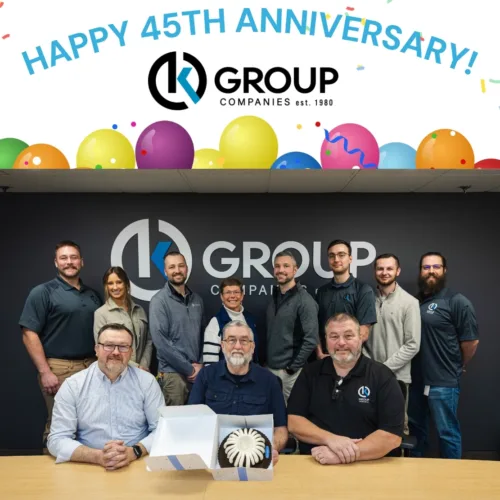 We had the pleasure of speaking with Ben Kuncaitis from K Group Companies, a second-generation family business that has been in the technology space for over 40 years. Ben shared his insider insights on how the industry has evolved, their company’s history, artificial intelligence, and how businesses can prepare for the constantly changing industry.
About K Group Companies

Founders Mike Sr. and Elouise Kuncaitis in the early days of K Group Companies
K Group Companies has a rich family history, dating back to 1979 when Ben’s father, Mike Kuncaitis Sr., founded the first of the K Group Companies. Mike Sr. had already been serving in the tech industry and saw a path forward to launching his own firm.
At the time, the main business consisted of supporting large mainframe computers, programming, and maintenance. They were “machines the size of a room,” explained Ben. “We had a division of our business that even fixed typewriters at one point.” Evidently, the industry has evolved significantly since their founding days.
When asked why his parents chose to work in the tech industry, Ben responded, “I think they saw it as the future. I think he was wise enough to know that.”
Ben, alongside two of his brothers – Chris and Mike, Jr.- have since taken ownership and operation of the companies. As Ben recalls, he and his siblings were integrated into the business early on. “I would say it’s in us. Tech brings a lot of challenges, and you have to like change. If you don’t like change, you’re in the wrong industry. He’s always taught us to run at challenges, not run from them.”
According to Ben, his father “had a high business acumen.” As Mike Sr. continued to build the company’s foundation, he prided himself on creating a true partner relationship with his clients by being their trusted tech advisor and consultant. To this day, this valuable legacy rings true with K Group Companies and how business is done. “We’re able to meet a client at their level and scale with them as they grow, by leveraging technology,” explained Ben.

The second generation leaders. Pictured from left to right Mike Jr., Ben, and Chris Kuncaitis
Industry Insights
In their more than forty years in business, a lot has changed in the industry. “As far as going from where the supercomputer was the size of a room, to where it can basically fit in the palm of your hand. That’s quite a swing.” Naturally, the landscape shifted alongside the structures themselves.
One industry shift is the focus on and importance of cybersecurity. This is an ever-changing topic and is one of the fastest moving areas of technology. “It’s not a matter of “if”, but “when”, there will be a breach,” said Ben. “A breach is going to happen, so it’s important to put yourself in a position of strength, in the healthiest way possible.”

K Group’s Evolution

The K Group team at a team outing
To support this, the company recently rebranded as K Group Companies, effectively combining their four primary divisions under one umbrella.
These divisions include Standard Computer Systems Inc., Riverview Service, K Data Systems, and Data Consultants. This approach allows them to provide clients with finely tuned solutions, provided by their team of highly skilled, experienced, and specialized professionals.
The unification of their brands brings better alignment to their new divisions in the previous individual companies, as well as making their services more accessible to customers that traditionally work with one or more of the teams.
Through internal growth with new ventures and acquisitions over the years, K Group Companies can provide services for about anything pertaining to technology. Much like technology itself, the family business K-Group Companies has consistently expanded and evolved along with the industry.
FBA Announces the Leadership Class of 2023
GRAND RAPIDS, MI / August 3 – Family Business Alliance is excited to announce the participants for Leading Forward, The Institute to Inspire and Develop Michigan’s Family Business Leaders.
Leading Forward is the only leadership program in West Michigan which connects family business leaders to learn and support one another on their leadership journey. The program invites family business leaders to hone their skills and overcome the unique challenges of family business leadership for the betterment of the family, the organization, and community.
 “These leaders are challenged not only with economic and market disruptions, but also the responsibility of stewardship to the family enterprise. They take on the responsibility of actively guiding the family members, imparting their values in the family and organization, and re-igniting innovation and reinvention by seeking new opportunities in a world that was very much different from the prior generation. Their success is critical to the family business culture and continued economic impact of West Michigan,” stated Robin Burns, Director of Family Business Alliance.
Leading Forward offers interactive facilitated sessions and learning opportunities from other local businesses who will share their visions and beliefs about leadership. They will tackle leadership styles, team development, effective boards, innovation, and culture.
The five-month program that features five half-day in-person workshops and one-hour individual coaching sessions will begin on August 9, 2023.
“These leaders are challenged not only with economic and market disruptions, but also the responsibility of stewardship to the family enterprise. They take on the responsibility of actively guiding the family members, imparting their values in the family and organization, and re-igniting innovation and reinvention by seeking new opportunities in a world that was very much different from the prior generation. Their success is critical to the family business culture and continued economic impact of West Michigan,” stated Robin Burns, Director of Family Business Alliance.
Leading Forward offers interactive facilitated sessions and learning opportunities from other local businesses who will share their visions and beliefs about leadership. They will tackle leadership styles, team development, effective boards, innovation, and culture.
The five-month program that features five half-day in-person workshops and one-hour individual coaching sessions will begin on August 9, 2023.
“These leaders are challenged not only with economic and market disruptions, but also the responsibility of stewardship to the family enterprise. They take on the responsibility of actively guiding the family members, imparting their values in the family and organization, and re-igniting innovation and reinvention by seeking new opportunities in a world that was very much different from the prior generation. Their success is critical to the family business culture and continued economic impact of West Michigan,” stated Robin Burns, Director of Family Business Alliance.
Leading Forward offers interactive facilitated sessions and learning opportunities from other local businesses who will share their visions and beliefs about leadership. They will tackle leadership styles, team development, effective boards, innovation, and culture.
The five-month program that features five half-day in-person workshops and one-hour individual coaching sessions will begin on August 9, 2023.
Introducing the first class of leaders:
- Brandon Bissell, Imperial Clinical Research Services
- Cameron Young, Behler – Young
- Elizabeth Avra, Apek Holdings LLC
- Geoff Miller, Grand Rapids Chair
- Kelly Slikkers, Tiara Yachts
- Robert Dunn, MountainAire Builders
- Ross Haan, Impact Fab, Inc.
- Steve Kloosterman, Westshore Electronics
- Todd Van Haren, SecurAlarm
About Family Business Alliance:
Family Business Alliance, West Michigan’s only association of family business organization, seeks to preserve our unique culture of family driven organizations. Established over 15 years ago by local leaders of family businesses, today we represent nearly 170 family run organizations with over 450 active representatives. Together we create connections, elevate leadership, and navigate governance to advance family business in the West Michigan Community. For more information about Leading Forward or Family Business Alliance, contact Robin Burns at robin@fbagr.org Written by Robin Burns

