Posted August, 2026

It’s in the Betten Blood
Three generations, two industries, one drive to improve
A family of businesses, separated by miles and industries.
One runs on hydraulics and precision. At MFP Automation Engineering, engineers design motion-control systems, custom manifolds are machined from solid blocks of metal, and finished systems are tested and tuned before they ever reach a customer.
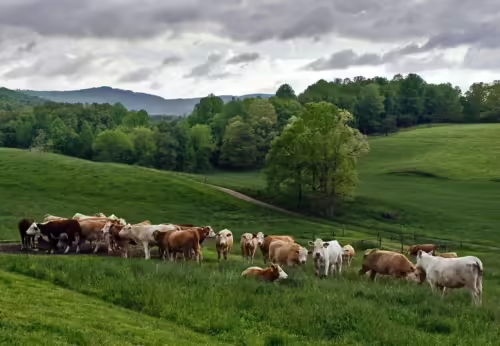
The other runs on genetics and livestock. At Betten Cattle Company, nearly 200 cattle move through pastures and steel-lined lanes. A yellow tag on an animal’s ear connects to a digital record that can be pulled up from an iPad in the field. Genetics can be studied before a calf is even conceived.
Spend time with the Betten family, though, and there are more similarities than differences.
“You’re still always searching for efficiencies,” said Sean Betten. “There’s always new ways coming about, so you always have to be learning and open to new ideas and different things. There’s more than one way to do a job.”
That mindset has been taking shape in the Betten family for generations.
A Mindset for Generations
Long before there was a Betten Cattle Company, and before MFP Automation Engineering grew into the operation it is today, there was Roger Betten Sr.
He was a hydraulic salesman with an entrepreneurial streak and an interest in trying something completely different.
In 1974, a large commission check gave him the opportunity to buy an 80-acre farm. There was no elaborate agricultural business plan behind the purchase. He liked animals. He bought a tractor. Then came a few cows.
“He bought a farm,” his son, Roger Betten Jr., recalled. “No reason at all.”
The farm grew alongside Roger Sr.’s career in hydraulics. In 1991, he and two business associates took another leap and started what would become MFP Automation Engineering.

His children and grandchildren grew up with a foot in both worlds. Roger Jr. remembers going to the farm every weekend beginning around age four. Sean, Roger Sr.’s grandson, remembers working cattle and farming from the time he was about 10, then heading to MFP and eventually studying hydraulic engineering.
Over time, each generation began putting its own fingerprints on what the generation before had built.

A Blank Sheet of Paper
Walk through MFP today with Roger Jr. and Peter Betten, and innovation is a way of operating.
The starting point can be remarkably simple: A blank sheet of paper.
“What are you begging for? What do you wish you could do? What’s your biggest headache?” Roger said of conversations with customers.
Maybe a manufacturer is waiting too long for a lift. Maybe a machine needs to move something faster, bend something differently or handle a heavy load more efficiently. The MFP team listens, then starts figuring out how to make it happen.
“We figure out the smartest way to move that,” Roger said.
That willingness to rethink the answer has become part of the company itself.
An Appetite for Change
Roger officially began leading MFP more than a decade ago, and his appetite for change quickly became apparent. Where his father could look at a successful operation and decide that “good enough is good enough,” Roger saw new technology and wondered what else might be possible.
“Something you can buy on Amazon today wasn’t invented 10 years ago,” he said. “We could maybe use this idea and this technology to make our product better.”


Today, one of the clearest examples sits in MFP’s warehouse. An automated inventory carousel holds roughly 80,000 SKUs and brings parts to employees after a barcode scan, helping the company store more product in less space and improve picking accuracy.
For Roger, the goal isn’t technology for technology’s sake. It is finding a better way to solve a problem.
“You start dreaming of innovative ways to make it a little better, a little easier,” he said.
Room to Be Wrong
He is also quick to admit that some of those dreams will be wrong. That does not bother him much.
“I embrace change more than anybody I know,” Roger said. “I am not afraid of the risk of it failing.”
If circumstances change or someone on his management team sees a better route, he wants to hear it.
“I have managers come up to me and say, ‘I don’t think that’s a good idea. Here’s what I’m thinking,’” he said. “I’m like, ‘You’re smarter than me. Let’s do that.’”
Peter sees that openness as one of the traits that has allowed MFP to keep evolving. Because the company works across industries, its team is constantly exposed to different ways of solving problems.
An idea seen in oil and gas might become useful months later on a completely different shop floor. Something learned in automotive, food production, or wind energy might spark a solution somewhere else.
“I embrace change more than anybody I know”
“It’s an openness to see and recognize other people’s good ideas and where you can implement those and how you can take advantage of those as well,” Peter said.
That habit of improving things traveled from the shop floor all the way to farm pastures.
Asking Why
Sean Betten has always preferred being outside.
“I like the dirt. I like the land, the sun more than being indoors and inside,” he said.


For years, he split his time between MFP and the cattle operation. In 2015, he started Betten Cattle Company with four heifers.
The beginning was rough. A mix-up with semen resulted in the loss of all four calves. So he started again. He bought 11 cattle and kept going.
By 2023, as his grandfather experienced health problems, Sean transitioned more fully to the farm. Today, the operation has grown to nearly 200 animals across cows, calves, yearlings and the feedlot.
He began looking at the cattle business much like his family looked at MFP, using technology to improve the herd from the ground up.
“There is so much technology in ag,” Sean said.
One of the biggest opportunities is genetics.
Known traits from a sire and dam can be evaluated before breeding to understand what a pairing might produce. At Betten Cattle Company, oocytes (immature egg cells) can be collected from young females, combined with selected genetics to create embryos, then transferred into commercial cows that carry the pregnancy.
“You can pre-make a cow before you actually do it,” Sean explained.
The approach is helping him develop one of the parts of the operation he is proudest of: full-blood Red Wagyu.
Betten Cattle Company is among the early operations to bring full-blood Red Wagyu genetics into Michigan. The foundation genetics of its bulls and donor animals can be traced back to the limited number of cattle originally imported into the United States decades ago.
Still, Sean has not thrown away everything the previous generation taught him. The work combines an old occupation with tools his grandfather never had.
When checking whether hay is ready to bale, technology can measure its moisture. Sean still reaches down and checks it by hand.
“I still do both,” he said. “Because that’s the way we learned.”
What Legacy Allows
There are reminders of Roger Sr. across both businesses.
At MFP, plaques and photographs preserve pieces of his career. Stories about him still surface in conversation. Family members remember a man who seemed incapable of turning work off.
At the farm, the evidence is harder to miss. The land itself is part of what he left behind.
“I don’t need to try and hold on to any of the old ways of doing it”
Sean knows that without his grandfather buying that first farm, his own cattle company may never have existed.
“The legacy is what provided me the opportunity to do this,” Sean said. That is also why he does not believe honoring his grandfather requires farming exactly as his grandfather did.
“I don’t need to try and hold on to any of the old ways of doing it,” he said. “Just because farming, agricultural, being a cattleman, stewardship, all of it has changed so much.”
To Sean, the opportunity is the inheritance.
Advancing it is how he honors it.


Designing What Comes Next
The next challenge for the Bettens is bigger than a hydraulic system or cattle operation.
They are trying to figure out how to carry both forward.
Peter represents the third generation stepping further into leadership at MFP. The company is entering a stage where the entrepreneurial energy that fueled years of growth needs to be paired with systems that can support the next phase.

“How do we implement processes and systems where we can have actual scalable growth that’s not going to cause burnout?” Peter said.
At the same time, the family is thinking about the generation coming behind him and Sean.
There are nine grandchildren in that next generation. Roger wants them to understand both sides of the family legacy. That might mean a summer on the farm picking up sticks and raking hay, or dusting in the MFP warehouse.
The family name creates the opportunity to learn the businesses. It does not guarantee a position in them.
“You can totally come help and work at MFP,” Peter said, “but you’re not going to be the systems engineer” simply because of the name on the building.
Roger also knows some of those children may grow up and choose something completely different.
“What if Sean’s son doesn’t want to be a farmer, he wants to be an engineer?” Roger asked. “How do we create this so it carries on…for the next handful of generations?”
It is a question the family is still working through.
What They Leave Behind
Roger Sr. could not have predicted automated inventory carousels, artificial intelligence or embryos carrying carefully selected Red Wagyu genetics when he bought that first farm in 1974.
He gave the next generation something to build from.
They intend to do the same.
The machines will change. The cattle will change. The technology certainly will.
And somewhere between the hum of MFP’s shop floor and the quiet of a pasture, another Betten will probably be asking the question that has carried the family this far:
Why do we do it this way?
Maybe that is what is really in the Betten blood.
Learn more about MFP at https://www.mifp.com/.
Learn more about Betten Cattle Company at https://bettencattleco.com/
Family Business Alliance provides tools, resources, and connections to help family businesses succeed. Learn more about our resources including Leading Forward, Succeeding at Succession, and Forging Frameworks of Governance that help to advance family business in our community.